
Remote Transformer Monitoring using DRYCORE Technology and DC-5M Systems
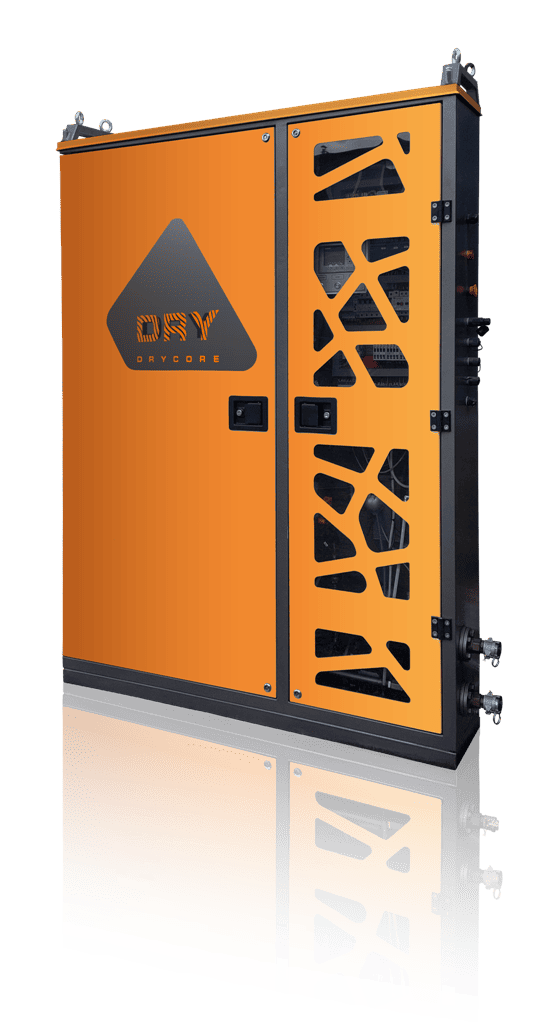
Remote transformer monitoring is an effective approach to addressing one of the most critical operational challenges of oil-filled power transformers — increased moisture content inside the transformer tank. Elevated moisture levels lead to a significant decline in operational reliability and a steady rise in operating and maintenance costs throughout the transformer lifecycle.
Excessive moisture inside a transformer tank can directly cause emergency failures. These failures are associated with a dramatic decrease in the dielectric strength of insulating oil, the occurrence of short circuits in transformer windings, and damage to high-voltage bushings. Even when moisture concentration is not sufficient to cause immediate insulation breakdown, it inevitably degrades transformer performance, reduces permissible operating parameters, and increases the total cost of owning this vitally important equipment.
Moisture content in the solid insulation of a new oil-filled power transformer after manufacturing and installation typically does not exceed 1 % by weight. During operation, moisture content in the windings insulation continuously increases and may reach up to 3% after 25 years or so, while the recommended limit is not more than 2 %. This long-term trend makes continuous condition monitoring essential.
Sources and Accumulation of Moisture in Transformers
There are two main sources of moisture entering a transformer tank. The first is external moisture ingress caused by design imperfections or operating conditions that allow ambient moisture to enter the tank. In this case, the moisture content of solid insulation may increase by up to 0.05 % per year.
The second source is internal moisture generation associated with aging and oxidation processes. Over a full cellulose aging cycle, up to 0.75 % moisture may be generated within the solid insulation. Furthermore, oil oxidation may contribute up to 1 % moisture relative to the weight of the insulation. As these processes progress, the need for drying the transformer insulation becomes unavoidable.
Up to 98 % of the total moisture present in a transformer is concentrated in the cellulose insulation of the windings, while the transformer oil contains, on average, only about 2 % of the total moisture. This distribution greatly complicates condition monitoring, as there is no direct access to the winding insulation during operation.
Forms of Moisture and Migration Processes
Moisture inside an oil-filled transformer exists in several forms, depending on its location and operating conditions. Free water may enter the tank as droplets or vapor and usually settles at the bottom due to its higher density. Dissolved moisture in oil is a stable and ever-present form. Moisture accumulated in solid insulation is also relatively stable.
The most dangerous forms are dynamic: dispersed microdroplets of water in oil and vapor bubbles within transformer windings. Dispersed moisture forms when temperature changes cause the solubility limit of water in oil to be exceeded. This condition is particularly hazardous at low temperatures, where moisture may crystallize, significantly reducing the dielectric strength of the oil.
Moisture continuously migrates between insulating oil and solid insulation during transformer operation. Temperature changes caused by load variations or ambient conditions strongly influence this process. When the oil temperature decreases rapidly, excess dissolved moisture is released throughout the oil volume in the form of fine droplets. Under the influence of an electric field, these droplets become polarized, align into chains, and may form conductive paths that reduce effective insulation distances and lead to breakdown.
Influence of Moisture on Insulation Reliability
Regardless of how moisture enters the transformer, most of it eventually accumulates in the solid insulation of the windings. The moisture content in cellulose insulation can theoretically reach up to 17% by weight, although much lower values can already have a severe negative impact.
Increased moisture accelerates cellulose aging, as water acts as a catalyst for insulation degradation. At moisture levels starting from 3–4% and at elevated conductor temperatures, water may boil within the insulation, forming vapor bubbles between the layers of transformer windings. These bubbles reduce the effective insulation thickness and may cause internal breakdowns, even though turn-to-turn insulation strength may still appear sufficient.
The temperature at which vapor bubbles form depends on multiple operating and design factors and may vary significantly across different zones of the windings due to competing moisture migration processes.
Remote Transformer Monitoring and Moisture Diagnostics
From the perspective of remote transformer monitoring, the most important task is to determine the optimal timing for insulation drying procedures. This decision cannot rely solely on standard threshold values; it must take into account individual transformer design features, oil properties, aging condition, and operating conditions.
There are several methodological approaches to estimating the moisture content of solid insulation. Laboratory analysis offers high accuracy; however, it is labor-intensive and unsuitable for continuous monitoring. Calculation-based methods using equilibrium distribution curves require real-time oil moisture sensors and are convenient for monitoring systems, but they offer limited accuracy, especially as oil properties change with aging. Direct moisture sensors installed in solid insulation show promising potential, although long-term operational experience with such sensors remains limited.
In practice, continuous monitoring systems typically rely on calculated moisture estimates supported by oil moisture sensors and analytical software.
Remote Transformer Monitoring DC-5M System
The DC-5M system is specifically designed for online transformer monitoring and moisture management using the DRYCORE analytical framework. It continuously evaluates the condition of insulating oil in power transformers, including traction, mining, marine, furnace, and wind turbine step-up units.
The remote transformer monitoring system forms a closed oil circulation loop, drawing oil from the bottom of the transformer and returning it to the top after passing through integrated sensors. Oil parameters are measured once per minute and transmitted to a cloud-based server, where DRYCORE algorithms calculate additional diagnostic indicators.
The DC-5M also supports both transformer oil dehydration and monitoring modes. The minimum oil flow rate is 0.13 gpm (30 liters per hour). The adsorbers can handle up to 2.4 gallons (9 liters) of water. The system operates without oil heating, reducing energy consumption and minimizing thermal stress on transformer components.