
Transformer Dry Out Procedure
Internal insulation systems used in power transformers are typically based on a combination of mineral insulating oil and cellulose materials such as paper and pressboard. During long-term operation, this insulation inevitably becomes contaminated with moisture due to thermal aging, oxidation processes, and interaction with the enviroment. The presence of moisture in transformer insulation is one of the key factors that negatively affects both reliability and service life.
Moisture does not remain evenly distributed between oil and solid insulation. The overwhelming portion accumulates in cellulose, where it directly influences electrical characteristics, chemical stability, and mechanical strength.
Negative Impact of Moisture on Transformer Insulation
The presence of moisture in transformer insulation leads to a complex set of degradation processes. First, it significantly reduces the dielectric strength of insulating oil and lowers resistance to partial discharges. This creates conditions for electrical breakdown, especially under transient overvoltages.
At the same time, moisture increases thermal losses inside the insulation system. This results in localized overheating, raising the probability of thermal breakdown and internal short circuits. One of the most critical consequences is the acceleration of cellulose aging. Experimental data show that increasing moisture content in solid insulation from approximately 0.5% to 7% can accelerate aging processes by up to 16 times. Moreover, the degradation rate is directly proportional to the amount of water present in the cellulose.
Moisture also promotes oil oxidation and increases the catalytic activity of metals such as iron. This leads to sludge formation and precipitation, especially in the presence of free water. In addition, the corrosive effect of oil on metallic components intensifies, further compromising transformer reliability.
Another important effect is the reduction of permissible loading. Increased moisture forces operators to limit operating temperatures in order to avoid insulation damage, effectively reducing transformer capacity.
Moisture Distribution and Diagnostic Criteria
A key feature of transformer insulation systems is that most moisture is located in solid insulation rather than in oil. Therefore, oil analysis is often used as an indirect method to estimate the condition of cellulose.
For example, when moisture content in oil reaches approximately 20–25 mg/kg (ppm), the moisture level in solid insulation may range from 2.5% to 4%. If the oil contains less than 10 mg/kg of water when sampled at about 140°F (60°C), the moisture content of solid insulation is typically within acceptable limits.
Temperature plays a critical role in such assessments. Because moisture solubility in oil increases with temperature, the most reliable results are obtained when samples are taken after prolonged transformer operation under significant load.
According to widely accepted practice and standards such as those from IEEE and IEC, moisture limits for cellulose insulation are generally defined as follows: for new or overhauled transformers, not more than 1% by weight; for transformers in service, not more than 2%; and for aged units, values up to 4% may be tolerated, although such conditions require increased monitoring.
Forms of Moisture in Cellulose Insulation
Moisture in cellulose insulation exists in two main forms: monomolecular and polymolecular.
Monomolecular moisture is strongly bound to cellulose molecules and has a relatively limited effect on electrical properties. In contrast, polymolecular moisture forms layers where water molecules are bound to each other, significantly increasing electrical conductivity and dielectric losses.
The transition between these two states occurs at a moisture content of approximately 4% by weight, corresponding to the completion of the monomolecular layer. Beyond this threshold, the electrical characteristics of insulation deteriorate rapidly.
At temperatures around 68°F (20°C), dielectric losses begin to increase sharply when moisture reaches 3–4%. At higher temperatures, around 140°F (60°C), even 1% moisture significantly affects insulation performance. This highlights the importance of moisture control in loaded transformers.
Bubble Formation and Thermal Risk
One of the most dangerous effects of moisture is the formation of vapor bubbles within insulation during operation. When a transformer is loaded, heating causes moisture to desorb from cellulose and accumulate in microcapillaries. As temperature increases, this moisture turns into vapor, creating internal pressure.
The temperature at which bubbles begin to form depends strongly on moisture content. In very dry insulation, bubble formation may start above 392°F (200°C). In contrast, in wet insulation, bubbles can appear at temperatures as low as 212°F (100°C), and in some cases even around 140°F (60°C) when dissolved gases are present.
The presence of bubbles significantly reduces dielectric strength in oil gaps, increasing the risk of internal failures. For this reason, recommendations from CIGRÉ and the IEC emphasize that moisture content in solid insulation during operation should be maintained at or below 2%. This limit minimizes the risk of bubble formation and helps prevent internal short circuits.
Aging Transformers and the Need for Gentle Transformer Dry Out Procedure
A significant number of transformers in operation today have exceeded their standard service life. Under normal conditions, replacing such equipment solely based on age is not always justified. However, long-term operation leads to moisture accumulation in insulation, often exceeding 2.5–3% after 30 years of service.
Traditional transformer dry out procedures, such as vacuum drying during overhaul, involve high temperatures and deep vacuum. While effective, these methods can negatively affect aged insulation, causing additional mechanical and thermal stress. This creates the need for more gentle drying techniques that can be applied without taking the transformer out of service.
Indirect Online Dry-Out: Principle and Advantages
A modern approach to transformer dry out procedure is based on indirect moisture removal through continuous oil processing. This method does not directly act on solid insulation. Instead, it relies on the natural migration of moisture from cellulose into oil.
When a transformer operates under load, moisture migrates from paper into oil due to temperature gradients. If the oil is continuously dried, it becomes capable of absorbing more moisture, creating a concentration gradient that drives further moisture removal from cellulose.
This approach avoids thermal overstress and mechanical damage, making it particularly suitable for aging transformers.
DC-260D and DC-260DH Systems: Implementation of Indirect Drying
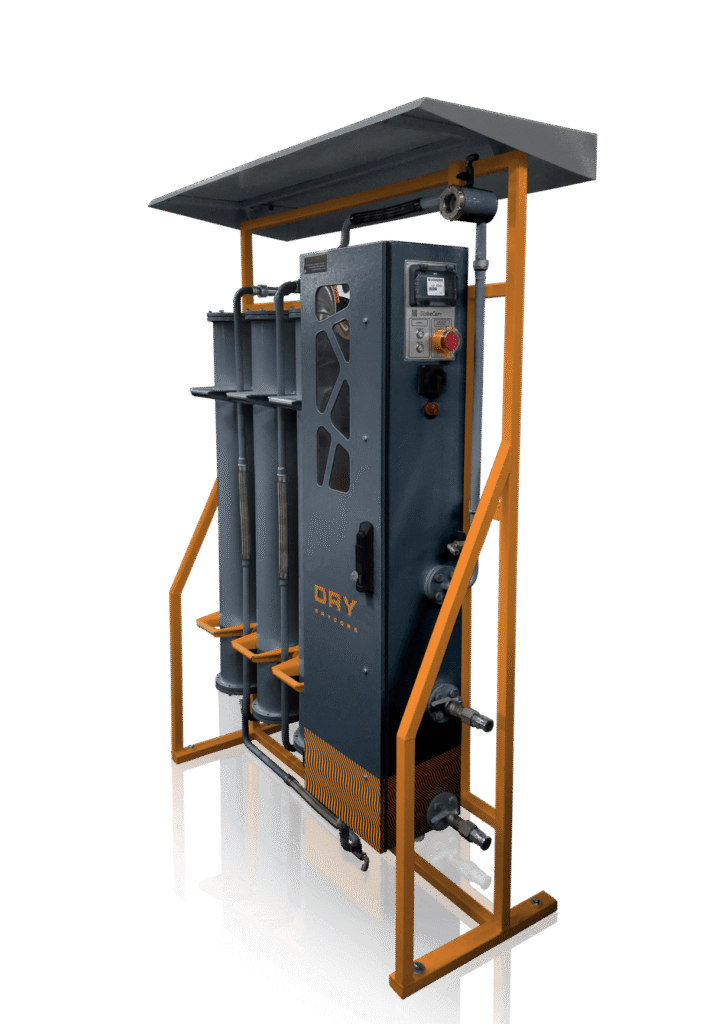
The DC-260D system is designed for online drying of transformer insulation using a closed-loop oil circulation process. Oil is extracted from the transformer, passed through cartridges filled with sorbent material (molecular sieves), where moisture is removed, and then returned back to the transformer. Over time, this process reduces moisture content not only in the oil but also in the solid insulation.
The DC-260DH system builds upon this principle by adding enhanced monitoring and control capabilities. It includes a protective housing, real-time measurement of moisture content at the outlet, and visual monitoring of sorbent saturation and filter contamination levels. These features allow operators to track the drying process and maintain optimal performance without interrupting transformer operation.
Both systems implement a continuous drying process while the transformer remains energized, making them particularly valuable in situations where outages are not feasible.
Indirect online drying technologies are particularly effective in situations where transformers cannot be taken out of service, yet the insulation condition requires improvement. This includes cases where moisture levels exceed 2-3.5%, where aging indicators such as reduced polymerization or presence of furan compounds are detected, or where transformers operate under high or variable loads.
They are also applicable when maintenance windows are limited, when transformers are installed in critical nodes of the power system, or when equipment has been in service for several decades and requires life extension measures.
While traditional drying methods remain effective, they are not always suitable for modern operating conditions. Indirect online drying technologies, such as those implemented in DC-260D and DC-260DH systems, offer a more flexible and gentle approach. By continuously removing moisture from oil and leveraging natural diffusion processes, they enable gradual drying of solid insulation without taking transformers out of service.
This approach not only reduces operational risks but also provides a practical path for extending the service life of existing transformer fleets while maintaining system reliability.