
Online Transformer Drying Systems
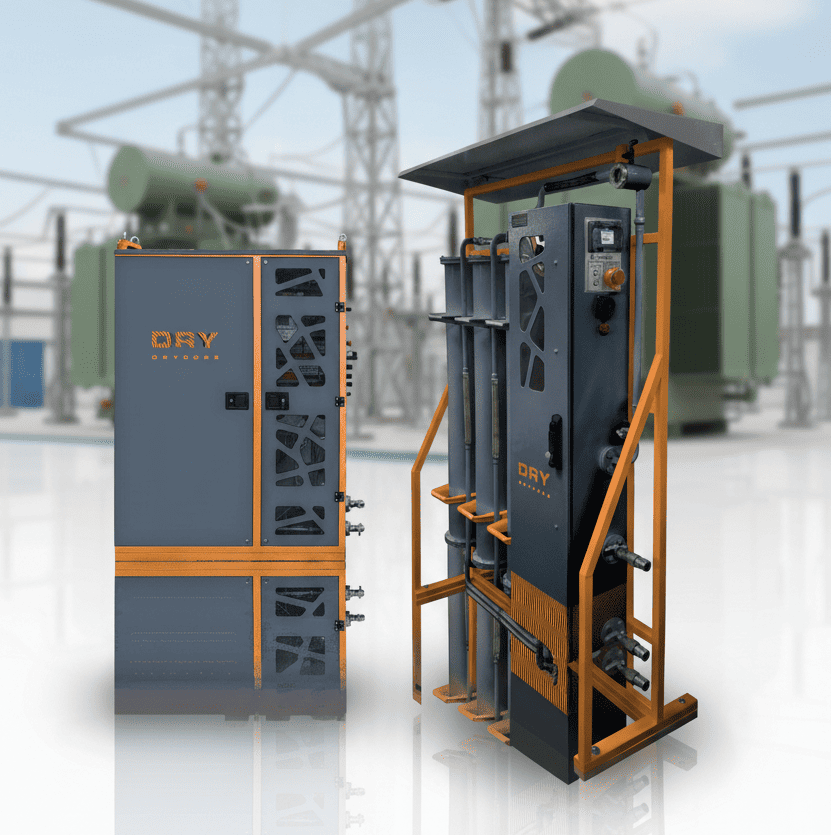
Moisture is one of the most persistent and destructive factors affecting power transformers. For utilities and industrial operators across the United States, maintaining transformers are directly tied to controlling insulation health. Online transformer drying systems have emerged as a practical, cost-effective solution that aligns with American standard, while eliminating many drawbacks of traditional drying methods.
Moisture Formation and Distribution in Transformers
Moisture inside a transformer originates from two primary sources:
- External ingress (ambient humidity entering through seals and breathing systems)
- Internal generation due to aging of cellulose insulation
When cellulose insulation degrades, it produces water (H₂O) as a byproduct. While solid isolation can only dissolve a limited amount of moisture, over 95% of the total water content resides in the solid insulation (paper and pressboard).
This imbalance creates a hidden risk. Even if oil appears relatively dry, the solid insulation may already be critically wet.
Increased moisture content leads to:
- Reduced dielectric strength of oil-paper insulation systems
- Formation of partial discharges and creeping discharges
- Danger of inter-turn faults and insulation breakdown
- Accelerated thermal aging of cellulose
- Increased risk of transformer failure during load or temperature fluctuations
According to IEEE guidelines (e.g., IEEE C57.106), moisture levels above 2–3% in cellulose insulation significantly accelerate aging and can reduce equipment life expectancy by several times.
Limitations of Traditional Drying Methods
Conventional drying methods are typically applied during scheduled maintenance outages and rely on elevated temperatures and vacuum conditions. These include hot oil circulation, vacuum drying, and hot air treatment, usually operating at temperatures of 185–212°F.
While such methods can be effective in the short term, they require the transformer to be taken out of service, involve complex logistics, and introduce risks related to thermal degradation of cellulose. High temperatures and vacuum exposure can lead to structural changes in insulation, including shrinkage, warping, and localized overheating. In large power transformers, where insulation mass is significant and geometries are complex, achieving uniform drying is particularly challenging, especially when moisture content exceeds 3%.
Principle of Online Transformer Drying Systems
Online drying technologies take a different approach by using the natural equilibrium between oil and solid insulation. When transformer oil is dried, it begins to absorb moisture from the cellulose insulation. This creates a gradual and controlled drying process without direct thermal or mechanical impact on the solid insulation.
This indirect drying mechanism allows moisture to migrate from paper to oil, where it can then be removed continuously. As a result, both oil and solid insulation are dried over time, while the transformer remains in operation.
DC-260D and DC-260DH Systems: Indirect Drying Technology
The DC-260D and DC-260DH systems implement this principle using DRYCORE technology. These units are connected to the transformer and remain in operation continuously, forming a closed-loop oil processing circuit.
The working cycle is based on closed-loop oil circulation. Oil is extracted from the transformer, passed through cartridges filled with a moisture-absorbing sorbent, and then returned in a dried state. As the dry oil re-enters the system, it absorbs moisture from the cellulose insulation. This process repeats continuously, gradually reducing the overall moisture content of the transformer.
The DC-260D provides the core drying functionality with a focus on efficient oil processing. The DC-260DH extends this capability by adding operational features such as a protective enclosure, real-time moisture measurement at the outlet, and visual indicators for monitoring sorbent saturation and filter condition. These enhancements improve operational visibility and support modern maintenance practices.
A key advantage of online drying systems is their ability to maintain a continuous drying cycle. As oil repeatedly absorbs moisture from insulation and is subsequently dried by the system, a stable moisture reduction process is established.
Operational and Economic Advantages
One of the defining advantages of this approach is that it operates without requiring transformer shutdown. This eliminates outage-related costs and avoids the risks associated with opening the transformer tank. At the same time, the continuous nature of the process ensures that moisture levels remain consistently low, rather than fluctuating between maintenance cycles. This is particularly important because the rate of insulation aging is strongly dependent on moisture content. Maintaining low moisture levels significantly slows down degradation processes, helping to preserve dielectric strength and extend service life.
Another important aspect is operational efficiency. Compared to traditional drying methods, which are labor-intensive and episodic, online systems function autonomously once installed. Over time, the continuous drying cycle creates a self-sustaining effect. As oil repeatedly absorbs moisture from the insulation and is subsequently dried by the system, the overall water content of the transformer steadily decreases. This not only improves reliability but also stabilizes performance under varying load and temperature conditions. The ability to maintain dry insulation continuously, rather than temporarily, represents a fundamental shift in transformer maintenance philosophy.
Online transformer drying systems offer a practical and technologically advanced solution to one of the most persistent challenges in maintenance operation. By focusing on indirect drying through oil processing, systems like the DC-260D and DC-260DH avoid the drawbacks of traditional high-temperature methods while delivering continuous, reliable moisture control. For operators seeking to extend transformer life, reduce failure risk, and optimize maintenance costs, this approach provides a compelling and forward-looking alternative.
A natural question arises in this context: if continuous moisture control can significantly slow insulation aging, how much additional service life could be unlocked across an entire transformer fleet?