
DRYCORE Transformer Oil Treatment Plant
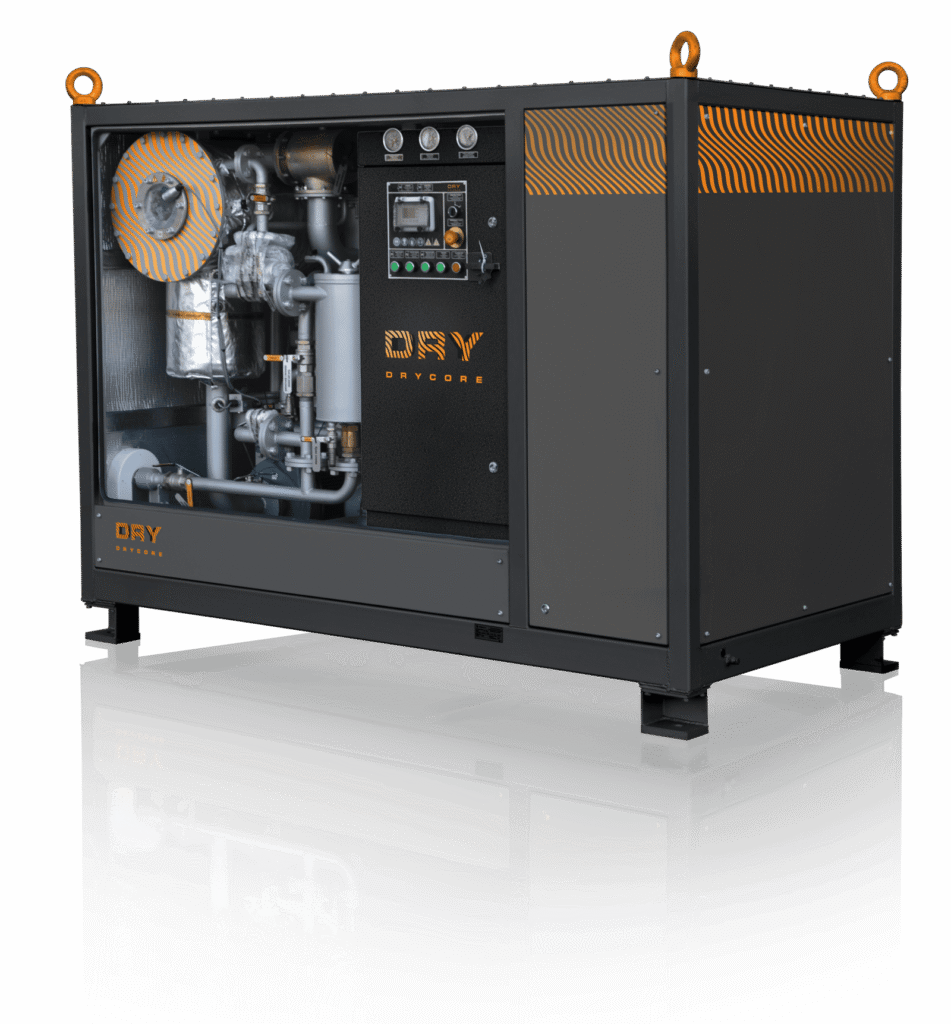
The DRYCORE transformer oil treatment plant is designed to address one of the greatest challenges in high-voltage electrical systems — maintaining insulating oil in a clean, dehydrated, and gas-free condition. As operating voltages of power transformers continue to rise, ensuring proper degassing, dehydration, and filtration of transformer oil becomes essential for reliability, dielectric strength, and long-term equipment performance. The DRYCORE system has been specifically developed to meet modern utility-grade standards for transformer installation, servicing, and lifetime asset protection.
Why Transformer Oil Must Be Treated
Transformer oil naturally absorbs air both from the environment and from gases dissolved within the fluid. This internal gas content significantly reduces the dielectric strength of both insulating oil and solid insulation and becomes a source of partial discharges that accelerate transformer aging.
Degassing is therefore not simply a maintenance procedure — it is a fundamental requirement for operational safety. For example, high-voltage transformers rated at 750 kV require evacuation of their tanks to levels below 0.029 psi (1.5 mm Hg), which typically takes at least 72 hours. Under a higher vacuum of 0.019 psi (1 mm Hg), the duration can be reduced to 48 hours. These values illustrate how strictly modern standards regulate vacuum drying and oil degassing as part of safe commissioning procedures.
Gas saturation processes are influenced by oil column height, the contact area between oil and gas, vibration within operating transformers, and thermal conditions. Any local pressure drops within the oil — especially under vibration — can force dissolved gases to form bubbles, introducing new high-risk discharge sites.
The DRYCORE system is designed to prevent these phenomena by restoring the oil to a stable condition with low gas and moisture content.
Understanding Vacuum and Gas Behavior in Oil Processing
Ensuring proper degassing of transformer oil requires an understanding of gas behavior under vacuum conditions. Pressures below atmospheric pressure (14.5 psi) are regarded as vacuum, and industrial systems typically operate within low (0.00014–0.019 psi (10–133 Pa)), medium (0.019–0.000014 psi (133–0.1 Pa)), and high (0.000014–1.45×10⁻⁹ psi (0.1–10⁻⁴ Pa)) vacuum ranges.
Gas molecules constantly collide with chamber walls, generating pressure. Reducing this pressure lowers molecular density and activity, allowing dissolved gases to escape from the oil surface. Vacuum systems also rely on sorption — the binding of gas molecules to internal surfaces — which is why all internal components must be properly degassed prior to high-vacuum operation.
Gas flow through pipelines is governed by pressure gradients, viscosity, molecular interactions, and vacuum system geometry. Pumping speed, conductance, and residual pressure determine how efficiently gases can be removed.
The DRYCORE system integrates these principles into a precisely controlled vacuum-thermal environment optimized for transformer oil purification.
Primary Functions of the DRYCORE transformer oil treatment plant
The DRYCORE transformer oil treatment plant performs three essential activities simultaneously:
- Filtration — removal of mechanical impurities and solid particles
- Degassing — extraction of dissolved gases
- Dehydration — removal of moisture and chemically bound water
This is how the DRYCORE system operates as a complete transformer oil treatment solution, capable of meeting the technical requirements of modern power systems.
Filtration Technology
First, the transformer oil passes through a coarse filter, which captures large contaminants and protects internal components from damage. This is the initial step of the comprehensive purification process.
After degassing and dehydration, the oil undergoes fine filtration, which may be mechanical or electrostatic. Mechanical elements made from dense polypropylene with a 5 μm pore size capture most microparticles. Their high dirt-holding capacity reduces operating costs and replacement frequency. Electrostatic separation removes even smaller particles, ensuring ultrafine purification that mechanical elements cannot achieve alone.
Both coarse and fine filters are designed with serviceability in mind — they can be cleaned or replaced quickly and easily.
Degassing inside the DRYCORE Transformer Oil Treatment Plant
In all DRYCORE-based systems, degassing is carried out in a thermal-vacuum chamber operating at 5–7 mm Hg. The oil enters the chamber through spray nozzles or foam dispensers, which significantly increase its surface area. Under reduced pressure and elevated temperature, dissolved gases are efficiently released from the oil.
Removing Moisture and Water from Transformer Oil
The same thermal-vacuum module also performs continuous dehydration. As water evaporates rapidly under reduced pressure and elevated temperature, moisture and dissolved gases are removed simultaneously.
Oil heating plays a crucial role: raising the oil temperature to 113 °F accelerates moisture evaporation and degassing. For this reason, DRYCORE systems equipped with heating modules deliver significantly faster and more complete purification.
The DRYCORE transformer oil treatment plant enables U.S. utilities to maintain their transformer fleets at the highest dielectric standards. By removing moisture, dissolved gases, and particulate contaminants, as well as preparing transformer tanks through precise vacuum evacuation, the system significantly extends transformer service life, reduces failure rates, and supports long-term grid stability.
If you need assistance in selecting the right DRYCORE system for your operation, we are ready to help ensure maximum performance and reliability of your electrical assets.