
DRYCORE transformer oil reclamation plant
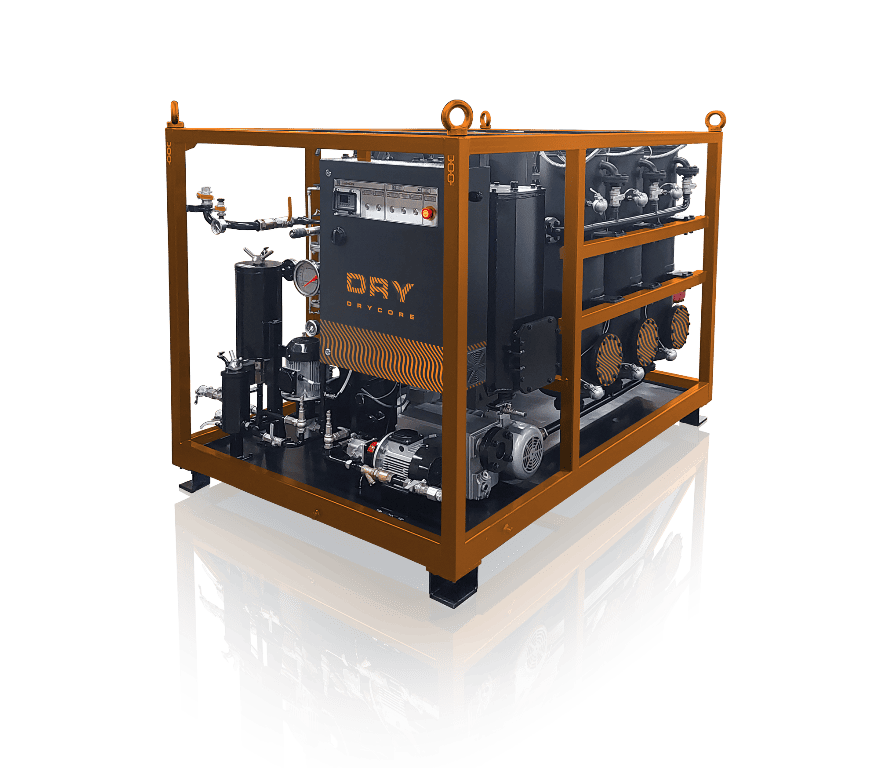
The DRYCORE transformer oil reclamation plant is responsible for one of the most important processes in power transformer maintenance: the deep restoration of the oil’s operational properties after aging. During transformer operation, chemical reactions, high temperatures, moisture exposure, and cellulose decomposition products gradually alter the chemical structure of oil. If routine reclamation is not performed, sludge, resins, asphaltenes, and deposits form inside the transformer tank, settling on the windings and the internal surfaces of the tank. As a result, this increases the risk of local overheating, deteriorates heat dissipation, and may lead to insulation failure.
New transformer oil has a light-yellow color, but after several months of operation, it darkens due to contamination, overheating, and oxidation processes. During accelerated aging or the ingress of foreign contaminants, the color changes much faster. Oil darkening is not a defect, but it indicates the degree of degradation. Particular hazards arise from the decomposition products of varnish coatings, insulation materials, and sludge formed from degraded oil. These products are hygroscopic and create conditions that reduce dielectric strength and promote the development of partial discharges.
Causes of changes in transformer oil properties
Transformer oil in a healthy transformer has a light-yellow color and high transparency.
Chemical methods
These methods use chemical agents that interact with contaminants and convert them into forms suitable for removal.
Common processes include:
- hydrogenation;
- alkaline-acid purification;
- oxidation;
- acid neutralization;
- purification using metal hydrides, carbides, and oxides.
Chemical methods can break the molecular bonds of resinous and asphaltene compounds, but they often require additional fine treatment.
Physical methods
Physical methods target the removal of moisture, mechanical impurities, and light fractions.
These processes include:
- centrifugation;
- gravitational sedimentation;
- magnetic and electrostatic separation;
- vacuum distillation;
- flushing and evaporation.
Vacuum is particularly important: at pressures down to 0.04 inHg, water and gases evaporate at significantly lower temperatures, helping to stabilize dielectric strength and reduce the risk of bubble formation.
Physico-chemical methods
Combining both techniques yields the best results.
Key processes include:
- selective adsorption of acids, sulfonates, resins, and asphaltenes;
- coagulation of colloidal contaminants;
- ion-exchange reactions.
Physico-chemical methods are the most effective for restoring heavily degraded oil. They combine adsorption and coagulation processes, in which special sorbents selectively remove polar compounds, acids, and resinous aging products. This group of methods forms the basis of the DC-R DRYCORE transformer oil reclamation plants.
DRYCORE transformer oil reclamation plant
The DRYCORE equipment line (DC-R series) consists of modern deep-sorption reclamation systems designed for the effective purification of transformer oil and other insulating oils without the use of acids, alkalis, or hazardous reagents. All DC-R systems operate on the same principle: the oil passes through a multicolumn sorption unit, where a special adsorbent captures oxidation products, sludge, resins, acids, and other polar contaminants. Owing to their design, DC-R systems ensure high reclamation speed, consistent purification quality, and long service life of the adsorbents, which can be reactivated for up to 500 cycles. The product range includes models with different capacities — from compact solutions for small substations to high-performance systems for large power facilities — with optional degassing and thermal-vacuum drying modules.
Efficiency depends on the condition and type of processed oil:
DC-12R — 4.4 to 8.8 gpm (1,000–2,000 L/h)
DC-6R — 1.98 gpm (450 L/h)
DC-10R — 3.3 gpm (750 L/h)
Physico-chemical processes in DRYCORE systems
The DRYCORE transformer oil reclamation plant uses adsorption processes based on Fuller’s earth. This adsorbent has a specific surface area of up to 250 square feet per gram and selectively removes:
- acids;
- resins;
- sulfonates;
- asphaltenes;
- oxidation and aging products.
It is adsorption-based reclamation that ensures the complete restoration of the thermo-oxidative stability, color, clarity, and dielectric strength of transformer oil.
Advantages provided by the DRYCORE transformer oil reclamation plant
The use of DRYCORE plants not only fully restores oil properties, but also slows down the degradation of solid insulation in the transformer. Removing polar aging products prevents sludge formation, which can block cooling channels and reduce thermal efficiency.
After reclamation, the breakdown voltage increases, while clarity and stability are restored. The transformer oil reclamation plant can also operate in conjunction with DRYCORE DC-D degassing modules, providing a complete purification cycle — from drying to deep sorption-based reclamation.
Key technological solutions of the DC-R series:
- continuous circulation through sorbent columns;
- the ability to regenerate the adsorbent without replacement;
- temperature control within 158–194 °F (70–90 °C);
- a 20–40% increase in breakdown voltage;
- a several-fold reduction in the dielectric loss tangent.
The result is the restoration of up to 80% of aged oil, which after treatment meets the parameters of new oil. This extends transformer service life by decades, especially when reclamation is combined with degassing and filtration.
Owing to the combination of multistage sorption, adsorbent reactivation capability, and adaptive modularity, DRYCORE represents one of the most reliable and cost-effective technologies on the market. Each DRYCORE transformer oil reclamation plant not only brings the oil to a like-new condition, but also allows the reclamation cycle to be repeated multiple times.