
Transformer Oil Refining with DRYCORE DC-D and DC-R machines
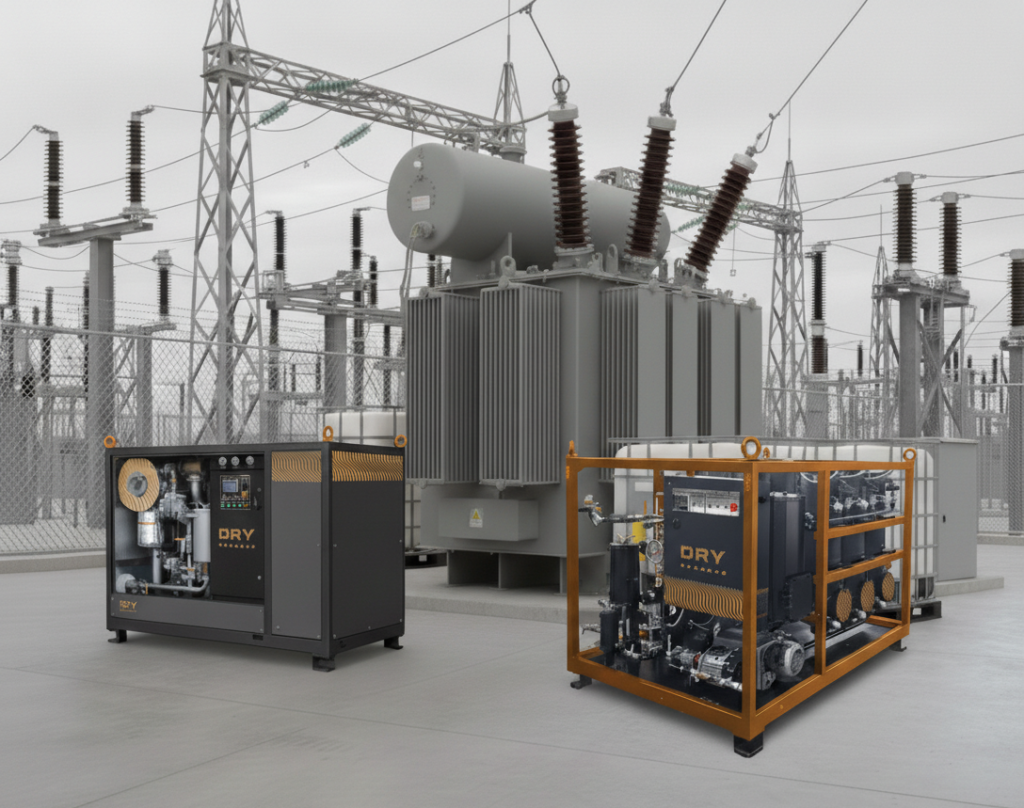
Transformer oil refining is a technical process that directly influences the operational reliability and service life of power transformers. Power transformers are among the most critical components of the global power infrastructure, with a total installed capacity estimated at approximately 3,030 million kVA. The safe and uninterrupted operation of substations depends heavily on transformer reliability, while unexpected transformer failures result in substantial economic losses. Since most power transformers are oil-filled, the condition of transformer oil is a key factor that determines insulation performance and dielectric strength.
Transformer Oil Refining and Insulation Degradation
One of the primary causes of power transformer damage is insulation degradation resulting from oil contamination and moisture ingress. During long-term operation, transformer oil accumulates solid particles, moisture, dissolved gases, and chemically active compounds formed as a result of oxidation and thermal aging.
The most hazardous contaminants are solid particles with sizes below 0.0002 inches. These particles account for approximately 95% of all contaminants present in transformer oil and are primarily oxidation by-products. Their presence significantly reduces dielectric strength and accelerates insulation aging. Emulsified water further decreases breakdown voltage, while dissolved gases, acids, and hydrocarbons adversely affect the dielectric loss tangent, leading to increased electrical losses and internal heating.
Contaminant Groups addressed by Transformer Oil Refining
Effective Transformer Oil Refining targets the removal of all major contaminant groups that impair oil performance:
- Solid oxidation particles smaller than 0.0002 inches.
- Free, dissolved, and emulsified water.
- Dissolved gases, including oxygen and degradation gases.
- Chemically active aging products such as acids and polar compounds.
Without timely oil treatment, these contaminants progressively deteriorate cellulose insulation, reduce breakdown voltage, and shorten transformer service life.
Technical Methods applied in Transformer Oil Refining
Industrial transformer oil treatment technologies combine several physical and chemical processes:
- Mechanical separation for removal of free water and solid impurities.
- Thermophysical treatment, including controlled heating, evaporation, and vacuuming.
- Physicochemical processes, such as coagulation and adsorption.
Oil treatment may be performed at regular intervals, after alarm events associated with a sharp drop in breakdown voltage, or based on chromatography and dissolved gas analysis. In most cases, transformers are disconnected from the electrical grid during deep oil treatment.
Before filling of electrical equipment, transformer oil undergoes deep thermal vacuum treatment. For transformers equipped with membrane or nitrogen protection, hermetic bushings, and sealed instrument transformers, air content shall not exceed 0.5% by volume, while water content shall be below 0.001% by mass. For transformers without membrane protection and with non-hermetic bushings, water content up to 0.0025% by mass is allowable. Mechanical contamination levels shall correspond to oil cleanliness class 11 for equipment rated up to 220 kV and oil cleanliness class 9 for equipment above 220 kV.
Transformer Oil Purification by means of DC-D Degassing and Drying Machines
The DC-D series is designed for comprehensive transformer oil purification through degassing, drying, heating, and fine filtration. Unlike conventional lubricating oils, transformer oil shall primarily retain high dielectric properties. Moisture, dissolved gases, and fine solid particles deteriorate these properties and render the oil unsuitable for continued service.
The DC-D machines restore dielectric strength by removing water and gases under controlled heating and deep vacuum conditions, while high-efficiency filtration eliminates solid impurities.
The DC-D machines operate in degassing, drying, and filtration modes with processing rates of 18 gpm, 26.4 gpm, and 44 gpm, depending on configuration. In heating and filtration modes, processing capacities reach 31 gpm, 30.8 gpm, and 66 gpm. These operating ranges allow DC-D machines to be used for both medium-power and high-power transformers during commissioning, routine maintenance, and emergency oil conditioning.
Transformer Oil Refining by Regeneration with the use of DC-R machines
Regeneration represents the most advanced form of Transformer Oil Refining, enabling restoration of waste oil to achieve the properties close to those of new oil. This approach supports resource efficiency and reduces the need for oil disposal and change.
The DC-R series employs the adsorption method, which is among the most effective regeneration technologies. Adsorbents such as silica gel, aluminum oxide, bauxite, bentonite, zeolites, and bleaching clays selectively remove oxidation products, acids, and polar compounds from the oil.
During regeneration, the transformer oil is run through multiple columns filled with high-capacity sorbent. As a result, oil color changes from dark brown to light yellow, and the acid number is reduced, restoring the dielectric and oxidative stability parameters.
Nominal process rates for DC-R machines
- 1.98 gpm
- 3.3 gpm
- 4.4–8.8 gpm
The DC-R machines are intended for oils with progressive aging where conventional purification alone is insufficient.
Integrated transformer oil solutions combining DRYCORE DC-D purification machines and DC-R regeneration machines provide a comprehensive approach to transformer oil lifecycle management. The DC-D machines remove water, dissolved gases, and fine solid impurities, while the DC-R machines eliminate chemical aging products at the molecular level.
Altogether, these technologies significantly extend transformer service life, stabilize dielectric parameters, and reduce operational risks in high-voltage power equipment.