
Transformer Oil Dehydrator DRYCORE: Integrated Moisture and Gas Removal Solution
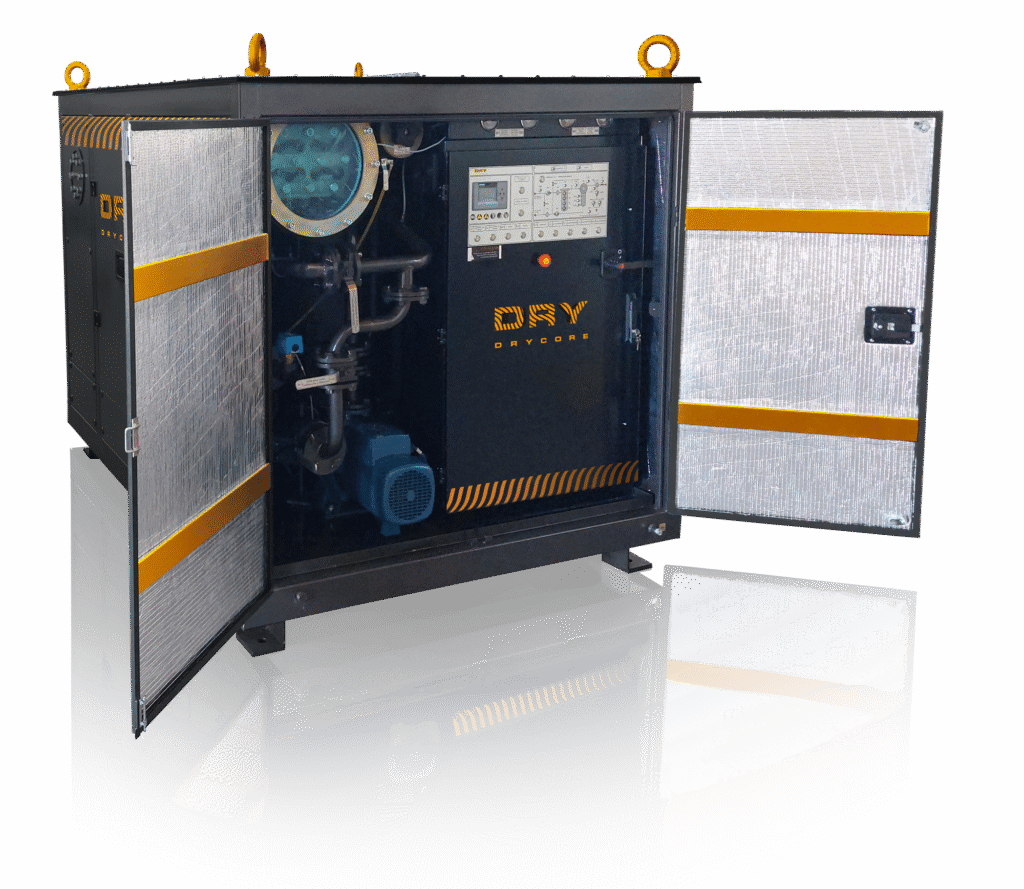
Transformer Oil Dehydrator technology is an important element of modern maintenance strategy for transformers. Transformer oil simultaneously performs insulation and cooling functions, which means its physical and chemical stability directly determines equipment reliability. During operation, oil inevitably absorbs moisture, dissolves gases, and accumulates solid particles. If these contaminants are not removed in time, dielectric strength decreases, oxidation accelerates, bearing wear increases, and the probability of insulation failure rises sharply.Traditional purification methods such as centrifuges and pressure filters have been widely used in the past. However, such equipment is complex in maintenance, generates significant oil and filter waste, and often demonstrates limited productivity. Modern vacuum systems working under the DRYCORE concept provide a far more efficient and technologically advanced approach.
Why Oil Purity Is Critical
Before applying any Transformer Oil Dehydrator, the actual condition of the oil must be assessed. When moisture content exceeds 500 ppm, the dielectric strength drops sharply. For example, contaminated oil may show breakdown voltage below 30 kV, while properly treated oil should reach at least 70 kV. Dissolved gases accelerate oxidation, and solid particles (such as iron, copper, or silica) increase wear and create conductive paths inside equipment.
Oil analysis frequency depends on equipment criticality and operating conditions.
Typical schedule:
- Critical equipment (large transformers, turbines): every 3–6 months
- Medium-priority equipment (hydraulic systems, gearboxes): every 6–12 months
Before commissioning new oil — mandatory, even fresh oil from storage may be contaminated.
Practical diagnostics clearly demonstrate why a Transformer Oil Dehydrator becomes necessary. For example, a measured water content of 480 ppm indicates critical contamination and requires immediate vacuum dehydration. An acid number of 0.38 mg KOH/g confirms oxidation has begun, meaning adsorption treatment may be required after moisture removal. An ISO cleanliness level of 22/20/17 reflects excessive particle contamination. Spectral analysis showing elevated Fe and Cu concentrations points to bearing and bronze bushing wear, often accelerated by moisture and abrasive particles. A silicon level of 45 ppm typically indicates external contamination such as dust or sand, suggesting that breathers and seals must be inspected.
Operating Principle of the Transformer Oil Dehydrator
The DC-44D Transformer Oil Degassing Machine operates on a controlled thermal-vacuum principle. Oil is heated to approximately 194°F (90°C) and then introduced into a vacuum chamber. Under deep vacuum conditions, the boiling point of water decreases sharply, allowing moisture to evaporate at relatively low temperatures without damaging the oil’s molecular structure. Water vapor and dissolved gases are extracted by the vacuum system, while dry oil is returned to the tank.
This process allows the Transformer Oil Dehydrator to remove not only free water, but also emulsified and dissolved moisture. At the same time, dissolved air and other gases are eliminated, preventing cavitation, slowing oxidation processes, and restoring dielectric strength.
Technical Performance
In degassing, drying, and filtration mode, the unit operates at a capacity of 44 gallons per minute, which corresponds to 10 cubic meters per hour. In heating and filtration mode, capacity reaches 66 gallons per minute, or 15 cubic meters per hour.
Processed oil parameters:
- Volumetric gas content: max 0.1%
- Moisture content: max 10 ppm
- ISO 4406 cleanliness class: 16/14/12
- Filtration fineness: 1 micron (39 microinches)
- Dielectric strength: minimum 70 kV
Using the DC-44D as a Transformer Oil Dehydrator is economically justified. The cost of purification is typically three to five times lower than the purchase of new oil. At the same time, waste generation is reduced, improving environmental performance. Because the unit is mobile, it can be delivered directly to substations or industrial facilities.
Instead of simple oil replacement, modern vacuum systems provide operators with a powerful tool for resource management and reliability control. By keeping moisture below 10 ppm, gas content below 0.1 percent, and dielectric strength above 70 kV, the Transformer Oil Dehydrator ensures compliance with manufacturer requirements and protects multimillion-dollar assets from premature failure.