
Moisture in Transformer Insulation
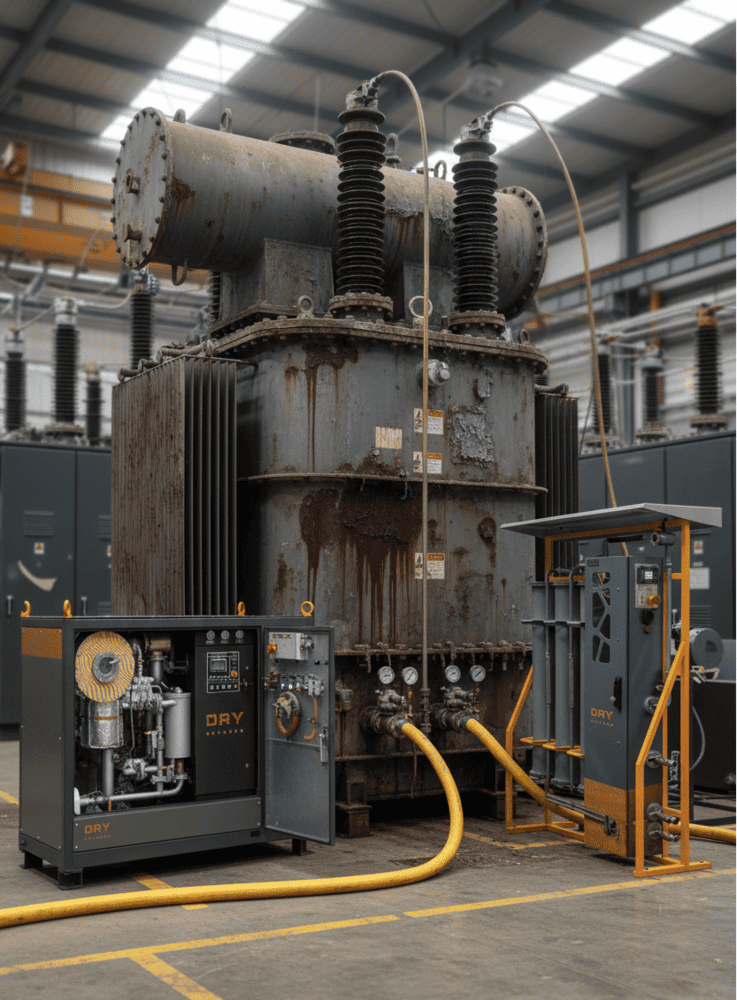
Electric power systems in the United States depend heavily on power transformers. From large utility substations supplying metropolitan areas to medium-size transformers serving industrial plants, hospitals, shopping centers, agricultural facilities, and petrochemical complexes, transformers are present almost everywhere electricity is generated, transmitted, or consumed. Despite their widespread presence, transformers usually remain unnoticed by the public. As long as electrical power flows without interruption, few people consider the complex processes that ensure transformer reliability.
However, transformers are among the most valuable and operationally sensitive assets in the electrical infrastructure. A single failure can lead to power outages, costly equipment replacement, environmental risks, and substantial financial losses. For utilities and industrial operators alike, maintaining transformer health is directly connected to operational stability and asset longevity.
One of the most influential factors affecting transformer reliability is the condition of its insulation system. Among the various threats to insulation performance, moisture is considered one of the most significant and potentially destructive.
Sources of Moisture in Transformers
Moisture can enter or develop inside a transformer through several mechanisms.
Atmospheric Moisture Ingress
The most common source of water in transformers is atmospheric humidity. Moisture can enter the transformer through:
- Breather systems with inadequate drying capability
- Imperfect seals and gaskets
- Pressure fluctuations during temperature changes
- Maintenance operations involving oil handling
Even well-designed transformers are exposed to ambient air during normal operation through their conservator breathing systems. If the moisture protection system (such as silica-gel breathers) is insufficient or poorly maintained, atmospheric humidity gradually penetrates the transformer.
Aging of Cellulose Insulation
A second significant source of moisture is the thermal aging of cellulose insulation.
During normal operation, transformer windings operate at elevated temperatures. Over time, the cellulose insulation undergoes chemical decomposition processes such as:
- hydrolysis
- oxidation
- thermal degradation
Water is one of the by-products of these aging reactions. As the cellulose insulation deteriorates, the amount of moisture released increases.
When the mechanical strength of the paper insulation drops significantly (for example when its tensile strength is reduced by more than half), water generation accelerates rapidly.
Moisture Solubility in Transformer Oil
Transformer oil has a relatively limited capacity to dissolve water. The amount of moisture that oil can hold depends primarily on temperature and oil composition.
Typical approximate values for moisture solubility in mineral transformer oil are:
| Oil Temperature | Water Solubility |
| 68°F (20°C) | ~37 ppm |
| 104°F (40°C) | ~85 ppm |
| 158°F (70°C) | ~270 ppm |
These values are widely referenced in transformer diagnostics under guidelines such as IEEE standards like IEEE C57 series for transformer maintenance.
When transformer oil cools rapidly (for example after a sudden load reduction), dissolved moisture may exceed the solubility limit and precipitate as tiny water droplets. These droplets form an emulsion and tend to accumulate on particles or solid surfaces inside the transformer.
Moisture Distribution Between Oil and Solid Insulation
A key feature of transformer moisture behavior is the dynamic equilibrium between oil and cellulose insulation.
In operating transformers:
- More than 98% of total moisture resides in cellulose insulation
- Only a small fraction is dissolved in the oil
Moisture constantly migrates between oil and paper depending on temperature changes. When temperature rises, water moves from paper into oil. When temperature drops, moisture returns to the paper.
Unlike transformer oil, the maximum moisture content of cellulose insulation is almost independent of temperature and can reach approximately 17% by weight when fully saturated.
Because most moisture is stored in the solid insulation, removing water from transformer oil alone does not fully solve the problem.
Periodic Oil Treatment with DC-D Transformer Oil Degassing Technology
Maintenance of transformer oil quality often involves specialized equipment designed for oil purification and degassing. One such solution is the DC-D transformer oil degassing machine, which is designed for servicing insulating and cooling oils used in high-voltage electrical equipment.
This technology is applied to transformers, on-load tap changers, transformer bushings, and high-voltage switches. During operation, the system heats and circulates transformer oil through purification stages where solid particles, dissolved gases, and moisture are removed from the liquid.
The system also allows evacuation of transformer tanks during maintenance procedures. When transformers are opened for repair or inspection, air and gases may enter the system. The DC-D equipment removes these gases by creating a deep vacuum environment.
The unit typically includes a vacuum processing chamber where pressure is reduced to facilitate degassing, vacuum pumps that generate and maintain the required pressure conditions, high-efficiency oil pumps for circulation, an integrated heating system, and a multi-stage filtration system designed to remove both coarse and fine particulate contamination. Depending on the operating mode, the processing capacity may range from approximately 18 to 44 gallons per minute during degassing and drying operations and from about 31 to 66 gallons per minute during heating and filtration mode.
Continuous Insulation Drying with the DC-260D Online System
While periodic oil purification improves oil condition, it does not completely solve the problem of moisture stored in cellulose insulation. Because more than ninety-eight percent of water inside a transformer is located in paper insulation, long-term drying requires continuous removal of moisture from the system.
One technological approach designed to address this challenge is the DC-260D online transformer dry-out system. This system allows transformer insulation to be dried while the transformer remains in normal operation.
The technology operates by connecting the DC-260D unit to the transformer and circulating oil through an external drying circuit. Oil is withdrawn from the transformer, passes through cartridges filled with highly porous sorbent material, and then returns to the transformer after moisture removal.
The sorbent granules used in the system contain a large number of microscopic pores that capture water molecules from the circulating oil. These granules do not contain chemical reagents but instead rely on their internal porous structure to physically absorb moisture.
Although the oil circulation rate of the system is approx. 0.13 gpm, continuous operation gradually removes moisture from the transformer. As water is extracted from the oil, equilibrium conditions inside the transformer cause additional moisture to migrate from the cellulose insulation into the oil, allowing progressive drying of the entire insulation system.
Continuous monitoring and appropriate drying technologies are necessary to maintain transformer health over decades of operation.
Solutions such as the DC-D oil degassing and purification system for maintenance operations and the DC-260D online drying system for continuous insulation drying represent practical approaches to controlling moisture and extending transformer service life.