
Transformer Oil Treatment Machine DRYCORE
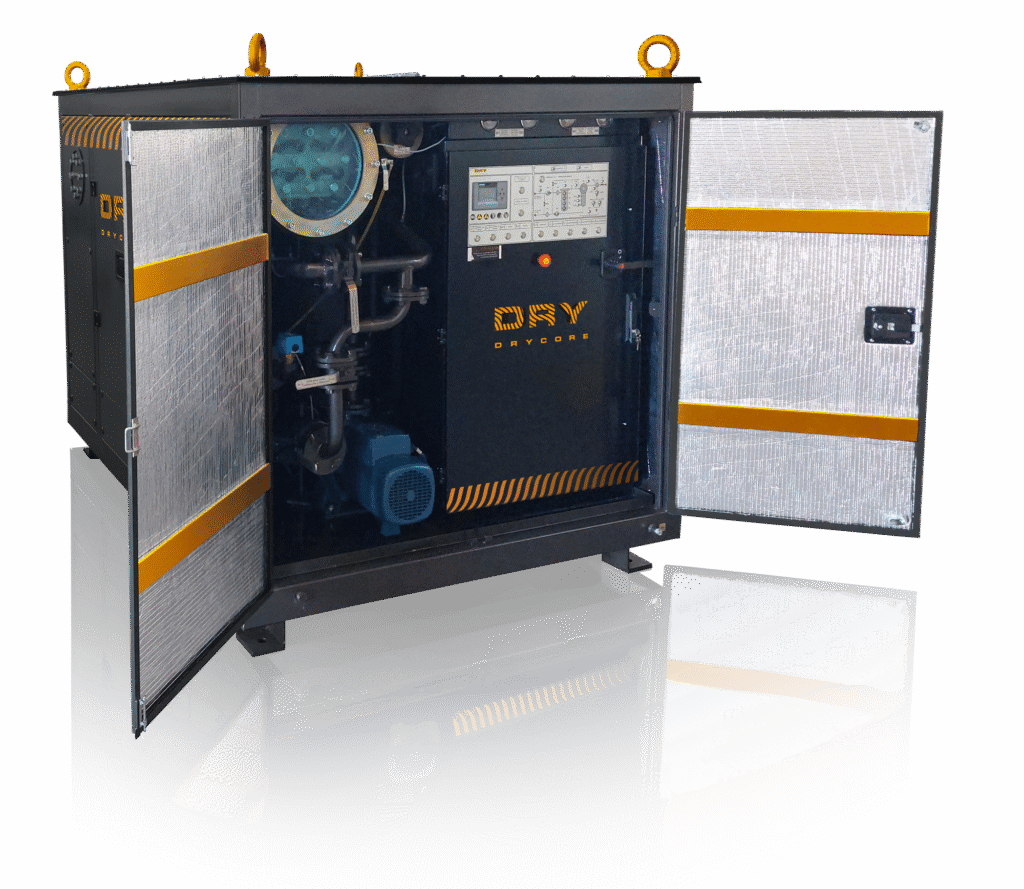
The quality of transformer oil determines the reliability of any power or distribution transformer, which is why a transformer oil treatment machine is an essential part of high-voltage equipment maintenance. Transformer oil performs several important functions: it provides insulation between current-carrying elements, removes heat from the windings, suppresses arc discharges, and absorbs moisture and gases formed as a result of oxidation and thermal aging.
The condition of transformer oil is evaluated using several key parameters. The dielectric loss tangent (tan δ) of clean oil at 194 °F and 50 Hz should not exceed 2×10⁻². However, in contaminated oil, this value may rise to 0.2, indicating a significant decrease in dielectric strength. Breakdown voltage is measured using a standard measuring cell with electrodes spaced 0.1 in (2.5 mm) apart; high-quality insulating oil should demonstrate a value of not less than 70 kV. Impurities, fibers, and especially water sharply degrade this parameter, so they must be removed to the lowest possible level.
Before being filled into transformers, the oil should undergo deep thermal-vacuum treatment. Gas content should not exceed 0.5% by weight for hermetically sealed units, and water content should be at or below 0.001%. For non-sealed systems, up to 0.0025% is acceptable. Oil purity grades required by ISO 4406 16/14/11 are Grade 11 for equipment up to 220 kV and Grade 9 for higher voltages. The DRYCORE technology is specifically designed to achieve these values.
Contamination Issues of Transformer Oil
The service life of a transformer is significantly longer than that of its oil, which often requires purification after the first year of operation. The oil’s tendency to absorb moisture leads to reduced dielectric strength, increased operating temperature, and accelerated insulation aging. In order to extend the service life of transformer oil, a set of measures is applied: limiting contact with atmospheric air, using filters to absorb moisture and oxygen, controlling temperature, removing sludge on a regular basis, and performing filtration. All of these measures become far more effective when a transformer oil treatment machine is used, as it enables deep dehydration and degassing of the oil, fully restoring its dielectric properties.
Design and Operating Principle of DRYCORE Equipment
DRYCORE has developed an efficient modular system in which all key components are integrated into an enclosed container: a vacuum chamber, vacuum and oil pumps, heating elements, a two-stage filtration system, and a control cabinet. This design makes the equipment suitable for on-site operation and minimizes the impact of external factors on process quality.
Dehydration is based on the thermal-vacuum principle: the oil is heated to a temperature at which water evaporates intensively under reduced pressure, after which moisture and gas vapors are removed by the vacuum system. This eliminates the need for adsorbents and avoids the generation of secondary waste. At the same time, the oil passes through filtration stages where mechanical impurities and solid particles are removed. This approach ensures comprehensive preparation of the insulating fluid for further operation.
An important feature is the ability to dry the internal space of transformers and tanks under vacuum, which is an essential step before filling the system with new or regenerated oil. Thus, the DRYCORE transformer oil treatment machine provides not only purification, but also a complete preparation cycle required before energizing the equipment.
Transformer Oil Treatment Machine (Dry Core)
The DRYCORE product line includes several models designed for oil treatment under different conditions and with varying capacity, but all of them are similar in technological concept. Regardless of whether it is the DC-44D, DC-26.4D, or DC-18D model, each DRYCORE transformer oil treatment machine uses the same deep thermal-vacuum processing principle, ensuring a low level of residual gases and moisture, as well as a consistently high purity grade.
The capacity of each DRYCORE transformer oil treatment machine depends on the operating mode and specific model:
DC-44D
• Degassing, dehydration, and filtration: 44 gpm
• Heating and filtration: 66 gpm
DC-26.4D
• Degassing, dehydration, and filtration: 26.4 gpm
• Heating and filtration: 30.8 gpm
DC-18D
• Degassing, dehydration, and filtration: 18 gpm
• Heating and filtration: 31 gpm
All of the above machines feature a containerized design, enabling easy transportation and operation at power substations, service centers, and in field environments. They can operate in pumping, heating, filtration, degassing, and external system vacuuming modes. Across the entire DRYCORE product line, the key advantages include low noise levels, energy efficiency, user-friendly operation, and minimal maintenance requirements. In any configuration, the transformer oil treatment machine ensures consistent processing quality and delivers oil with excellent dielectric properties even after a single treatment cycle.
A key advantage of the DRYCORE transformer oil treatment machine is its operation without adsorbents, which eliminates the need for handling and disposal of spent materials. The thermal-vacuum method ensures consistently low levels of dissolved gases and moisture. DRYCORE machines can easily switch between pumping, heating, degassing, and vacuuming modes, enabling a complete equipment preparation cycle prior to operation.