
Transformer oil degassing plant
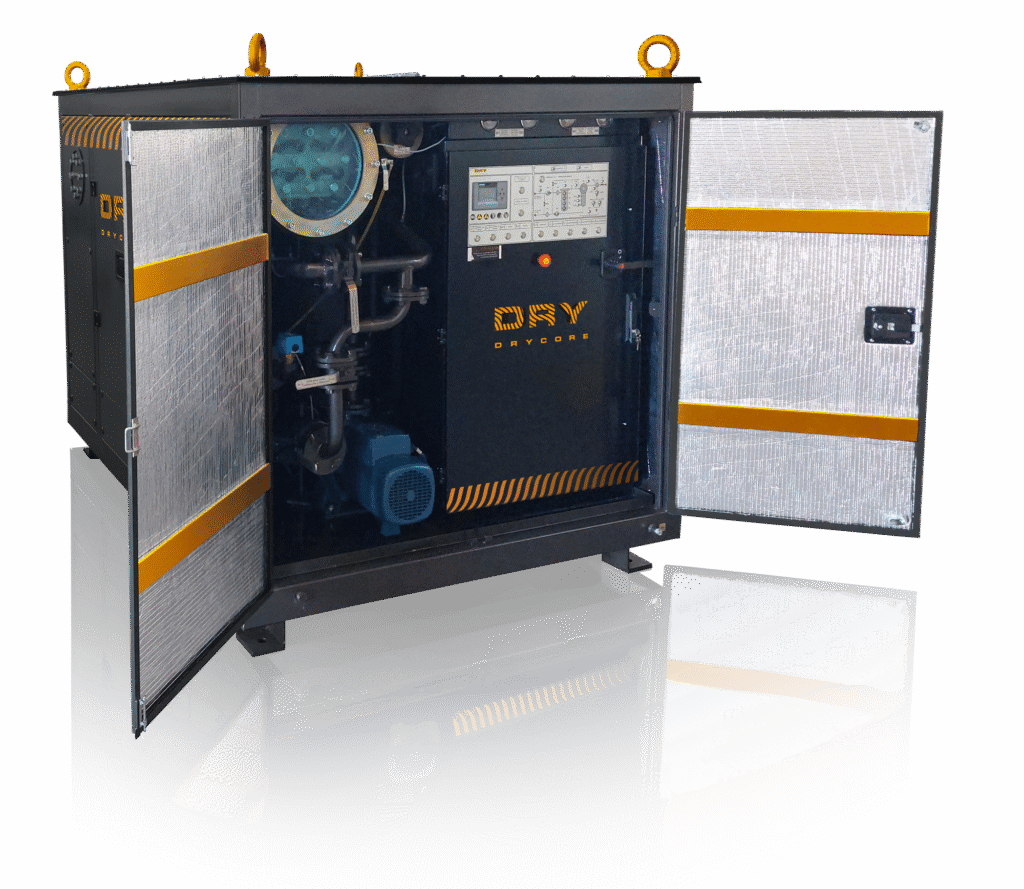
Transformer oil degassing main principle is in removing dissolved gases and air from insulating oil in electrical equipment. The goal of transformer oil degassing is to improve the dielectric strength of the oil and prevent transformer breakdowns caused by the presence of gases and moisture. During operation, transformer oil gradually absorbs air, water vapor, and decomposition gases. If not removed, these impurities reduce insulation resistance and accelerate oil oxidation, which can lead to internal discharges and even transformer failure.
Typically, fresh transformer oil already contains about 10% air by volume at atmospheric pressure, and this solubility increases with temperature. Before degassing, the oil is dried to a moisture content not exceeding 0.001% (10 g of water per 1 m³ of oil). Proper transformer oil degassing ensures the oil meets all industrial standards and provides long-term protection for high-voltage equipment.
Principle of Transformer Oil Degassing
In most degassing systems, the process occurs under deep vacuum. The oil is heated and then sprayed into a vacuum chamber where the dissolved gases are released and removed by vacuum pumps. The degassing unit typically contains Raschig rings or similar media that increase the surface area of the oil film, improving the degassing efficiency.
After degassing, the residual gas content in the oil does not exceed 0.04% by volume. The treated oil is then transferred to the transformer tank, which is kept under the same vacuum to prevent reabsorption of gases.
This technology not only removes air and moisture but also stabilizes the chemical composition of transformer oil, preventing oxidation and ensuring reliable transformer performance.
DryCore Transformer Oil Degassing Plants
DryCore transformer oil degassing plants combine multiple functions in one compact system — oil heating, filtration, vacuum dehydration, and degassing. These plants are available in stationary or mobile versions, depending on the service requirements.
- DC-18D Transformer Oil Degassing Machine small-capacity unit (up to 4 m³/hour / 17.6 gpm) – used for servicing small transformers or laboratory testing.
- DC-26.4D Transformer Oil Degassing Machine medium-capacity unit (6–10 m³/hour / 26.4–44 gpm) – suitable for substation maintenance and field repairs.
- DC-44D Transformer Oil Degassing Machine high-capacity system (15 m³/hour / 66 gpm and above) – used in power plants and transformer manufacturing facilities.
Units can be stationary, intended for permanent installation, or mobile, mounted on trailers or skids for on-site transformer servicing. Each transformer oil degassing plant is equipped with automated control panels that regulate vacuum level, temperature, flow rate, and pressure to maintain optimal process conditions.
Advantages of Using Transformer Oil Degassing Plants
Transformer oil degassing plants offer several benefits:
- Restoration of the oil’s dielectric strength to ≥70 kV, ensuring electrical safety.
- Removal of moisture and gases down to 0.1% gas content and 10 ppm moisture.
- Extended transformer lifespan through improved oil quality.
- Reduced operational risks, oxidation, and corrosion.
- No use of adsorbents or chemicals — fully eco-friendly operation.
- Energy-efficient systems with low noise and maintenance requirements.
Transformer oil degassing is a part of transformer maintenance, ensuring insulation integrity and long-term reliability of high-voltage systems. Equipment such as the DC-44D, DC-26.4D, and DC-18D from DryCore demonstrates the effectiveness of modern transformer oil degassing technology — providing high purification levels, operational flexibility, and energy efficiency.