
Transformer oil degasification plant
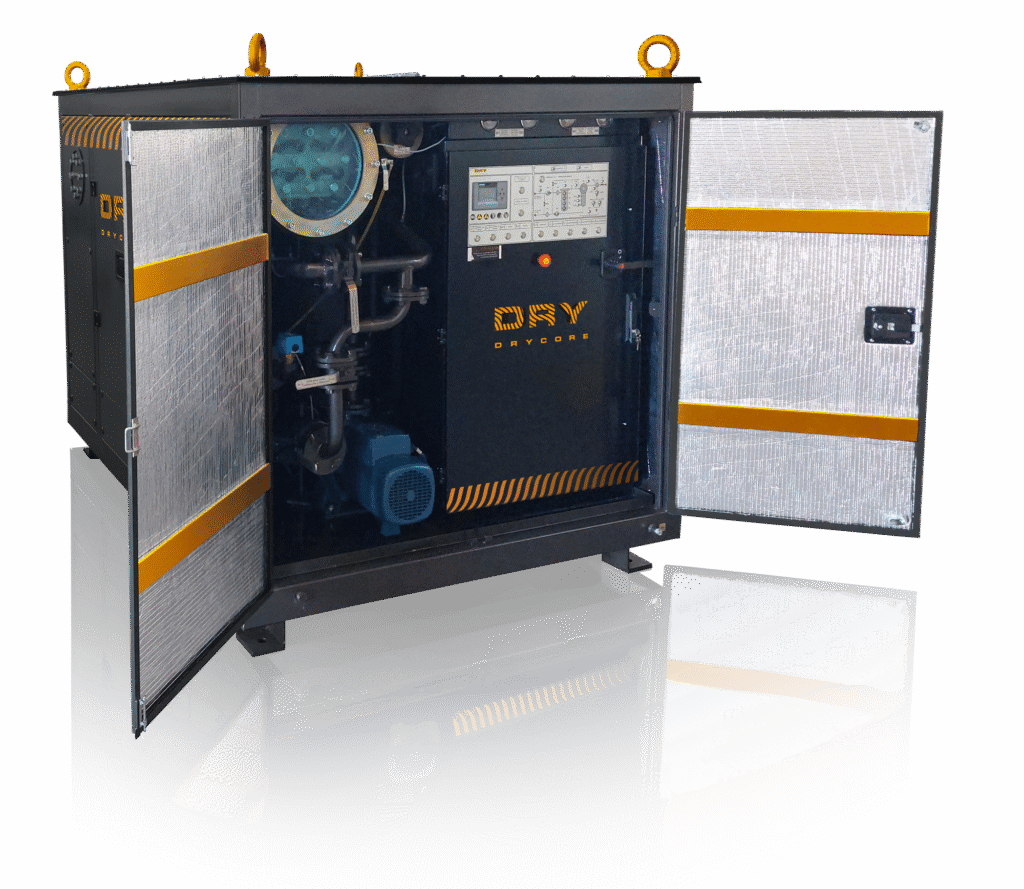
Transformer oil degasification is a process needed for high-voltage electrical equipment. During the service life of transformers, the insulating system undergoes various physicochemical changes that lead to the formation of decomposition products — solid, liquid, and gaseous substances. These changes are intensified when the insulation becomes moist. Both solid insulation materials based on cellulose (such as paper and cardboard) and transformer oil release gases during gradual aging. Among these gases are hydrogen, low-molecular hydrocarbons, as well as carbon monoxide and carbon dioxide, which appear as a result of cellulose oxidation.
The formation of gaseous decomposition products in insulation materials under the influence of electric fields, discharges, and heat is an inevitable phenomenon for any operating electrical device. The gases dissolved in the oil of power transformers can include methane (CH₄), ethane (C₂H₆), ethylene (C₂H₄), acetylene (C₂H₂), propane (C₃H₈), propylene (C₃H₆), butene (C₄H₈), and butane (C₄H₁₀). When insulation damage occurs, the intensity of gas formation increases sharply, and the composition of gases changes significantly. The presence of a gaseous phase in the insulation complicates the operation of high-voltage equipment and, in turn, further accelerates gas generation.
Gases may enter transformer oil not only from the surrounding air but also as a result of accelerated insulation aging. The primary cause of this process is transformer overheating. When the oil decomposes due to overheating, it produces gaseous substances such as ethane, methane, and hydrogen, which are highly soluble in the insulating liquid. If oil-impregnated paper decomposes, gases such as carbon dioxide, hydrogen, and carbon monoxide appear in the oil. Additionally, gaseous substances can form in transformer oil due to partial discharges within the insulation.
Causes of Gas Formation in Liquid Dielectric
The main reason for oxidation and degradation of liquid dielectric is the presence of air. Oxygen initiates chemical reactions that cause the breakdown of oil molecules and the formation of acidic and gaseous products. Therefore, transformer oil degasification plays a key role in halting these destructive processes. By removing gases and moisture, it is possible to extend the operational life of the transformer and ensure stable dielectric strength of the insulation system.
The solubility of gases in transformer oils varies depending on temperature and pressure. For instance, at 77° Fahrenheit and a pressure of 736 mmHg, oxygen from the air can dissolve in oil up to about 3%, while nitrogen has a solubility level of nearly 7%. This means that without proper degasification, the oil continuously absorbs gases from the atmosphere, leading to its deterioration and the risk of electrical breakdowns.
The Process of Transformer Oil Degasification
Transformer oil degasification occurs during the oil drying process. Specialized systems — such as DC-type degassing units — are used to remove gases from transformer oils. These units perform not only degasification but also purification from solid particles, moisture removal, and transformer vacuuming. The operating range of these units covers oils with viscosities up to 70 cSt at a temperature of +50°C.
The degasification process generally involves several stages:
- Heating — The oil is preheated to reduce its viscosity and enhance the release of dissolved gases.
- Vacuuming — The oil is exposed to a vacuum environment where the pressure is reduced, enabling the extraction of air and gases from the liquid.
- Degasification and Drying — Under vacuum, gases and moisture are efficiently removed from the oil.
As a result of transformer oil degasification, the purified oil achieves the following quality indicators:
- Gas content — no more than 0.1% by volume;
- Moisture content — no more than 5 ppm (g/t);
- Cleanliness class according to ISO 4406 — -/14/12.
These parameters ensure that the regenerated oil fully restores its insulating and cooling properties, guaranteeing safe and reliable transformer operation.
DC Transformer Oil Degasification Units
DC transformer oil degasification systems are designed for both stationary and mobile use. The units can service power transformers directly on-site, performing simultaneous oil filtration, moisture removal, and vacuuming of the transformer tank. Advanced models are equipped with automated control systems, temperature sensors, and vacuum regulators, which make the process fully controllable and efficient.
By maintaining optimal operating conditions, transformer oil degasification units prevent oxidation, reduce the risk of dielectric breakdowns, and extend the lifespan of both the oil and the transformer insulation.
Transformer oil degasification helps transformers work longer and more reliably. When gases and moisture are removed from the oil, it stays clean and stable, which means the insulation doesn’t break down as quickly. As a result, the transformer runs cooler, lasts longer, and requires less maintenance over time.